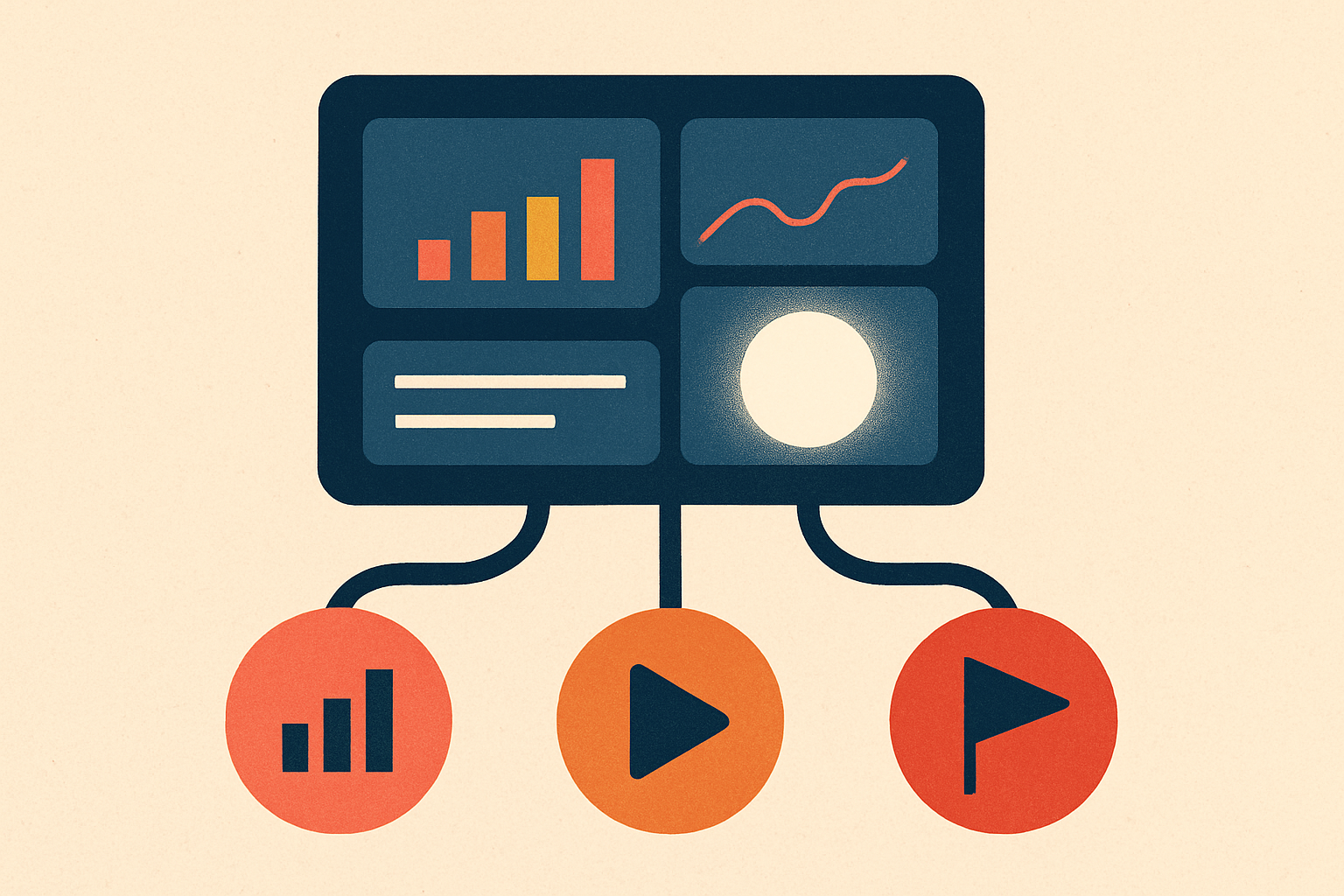
A published artifact used to be a snapshot frozen at build time. Now it can fetch through MCP connectors every time someone opens it — using the viewer's own connections. Here's what shipped, how it works, and the one prompt that builds it.
Google renamed Vertex AI to the Gemini Enterprise Agent Platform and folded Agentspace into it. Your API endpoints didn't change — but the console, the billing, and the mental model did. Here's the map from old names to new, and the one line item worth a second look.
PyTorch 2.13 brought the fused FlexAttention kernel to the Metal (MPS) backend. Here's the working code for the three masks you'll actually reach for — causal, sliding-window, and document-packed — on the Mac you already own.
Oak came out of stealth on July 15 with $60M to give AI agents real identities — and the same week, MCP's spec made scoped agent auth mandatory. When the money and the standard point the same way, it's time to look at what your agents are actually allowed to do.
Strict mode kills the invalid-JSON problem you used to spend afternoons on. But three failures walk right through it — truncation, refusal, and a safety stop — and each one wants a different move, not another retry.
When a browser client sends the conversation back to your agent every turn, it can smuggle in a system prompt, a rogue file URL, or a dangling tool call. Pydantic AI v2.5 ships the sanitizer — and shipped one subtle bug worth understanding.
In three releases across five days, the OpenAI Agents SDK made GPT-5.6 the default and quietly added 'hosted multi-agent beta support' — a path to run agent fan-out on OpenAI's infrastructure instead of your own. Here's what's actually in 0.18, and the decision it forces.
The 2026-07-28 spec deletes the handshake and the session. Here's the concrete diff — drop `initialize`, read capabilities from `_meta`, and replace held-connection elicitation with Multi Round-Trip Requests — with old-vs-new code for each step.
Mem0's token-efficient rewrite stops doing UPDATE and DELETE when it stores a memory, and pushes the hard part — reconciling contradictions — to read time. That's not a free win. It's a bet about where you can afford to spend.
On Agents' Last Exam — the benchmark for long-running professional workflows, where agent products actually die — GPT-5.6's cheapest tiers now clear a bar that Claude Fable 5 couldn't. The premium you pay for a frontier model just stopped being obvious.
Google quietly shipped a media tier cheap enough to call per request: images at $0.034 per thousand and video at ten cents a second. Here's the model IDs, the pricing math, and copy-paste code to wire both into a product.
Mistral's first physical-AI model guides a robot through spaces it has never seen using a single RGB camera and a sentence — no LiDAR, no depth sensors, no map — and it outscores rigs that carry all three. The 'physical AI is a 2027 problem' assumption just expired.
Every MCP tool you bolt on gets serialized into context on every call. Here's the reproducible way to count exactly what that costs — in tokens, latency, and accuracy — before you spend a dollar guessing.
Google's new agent-first Android toolchain lets Claude Code, Codex, and Gemini build, run, and test Android apps from the terminal — for 70% fewer tokens.
The comparison table asks 'which parser is best.' Wrong question. The right one is: how hard are your documents to read? Pick the cheapest tool that survives them — and only pay for a vision model when your PDFs actually earn it.
Most early products end up wiring together an analytics tool, a session-replay tool, a feature-flag service, an A/B testing service, and — lately — something to watch their AI calls. PostHog is all of those in one open-source platform, free until you're big enough to notice.
In a week when three vendors shipped new frontier models, the smartest move isn't picking one — it's staying swappable. OpenRouter puts 300+ models behind one OpenAI-compatible endpoint, so you change a model by editing a string.
It started as 'run Llama on your Mac.' In 2026 it's how a small team runs open-weight models — Kimi, GLM, DeepSeek, Qwen — locally or hosted, behind the same API your code already speaks. Fresh off a $65M round.
A step-by-step walkthrough from an empty folder to a running app you can deploy to one $5 server — no Redis, no Node build pipeline, no PaaS. The boring stack, on purpose, with every command.
A new benchmark maps the ways agents fail to the spans that would catch them. The GenAI conventions instrument the LLM call and the tool call — and go blind on planning, reasoning, guardrails, delegation, and memory.
The agent-memory leaderboard is fought on LoCoMo, a passive-recall test. MemoryArena couples memory to action — and the same near-perfect systems fall 40 points. The gap isn't inflation; it's the wrong exam.
Everyone reports the hit rate. The number that decides whether a semantic cache is safe to ship is the false-positive rate — and the fix for false positives eats the exact win you installed the cache to get.
The token-share charts everyone is quoting measure the wrong thing. On the same marketplace where Chinese open-weight models now move most of the tokens, Anthropic — with roughly an eighth of the volume — still captures nearly half the revenue. That gap is the whole story.
Sharding vectors is nothing like sharding rows. The real decision isn't where the data lives — it's how many shards each query is allowed to skip, and what recall you pay to skip them.
A new multi-turn coding benchmark reconstructs 109 real user sessions and scores agents on a second axis SWE-bench never had: not just whether they finished, but how much you had to steer them there.
Wrapping every model call in retry(3) feels responsible. Under a provider brownout it's the fastest way to turn a slowdown into a blackout. The fix is a budget, not more backoff.
An agent is a chain of steps that each depend on the last, so a 24-hour batch window can't sit on the critical path. You can't batch the loop — but the token-heavy work around it is exactly what batch was built for.
The headline savings from semantic caching are real — and they come from a workload your agent doesn't have. Two different things are both called 'caching,' and only one of them is safe to put around a tool call.

 🎧 Listen
The Stack
🎧 Listen
The Stack