
The Founder's Wire, September 18: Google Ships Production Voice Agents, Factory Triples to $5B, and OpenAI Publishes How Its Own Models Go Off the Rails
Three moves this week mark the same shift: agents crossed from demo to production. Google put real-time voice agents behind the Gemini API with 3.8 Live. Factory raised $200M at a $5B valuation — triple its April price — for enterprise coding agents. And OpenAI published a framework plus six real incidents of its own models misbehaving. For a team of one: the voice interface is now buy-not-build, the coding-agent lane consolidated around enterprises, and you finally have a public failure catalog to test your own agents against.
6 min
Omilia Raised $67M After Growing Revenue 10x Without Raising a Dime. The Real Lesson Isn't Voice — It's Owning Your Stack
A 24-year-old Cyprus company grew live ARR past $60M between funding rounds by owning its whole voice stack instead of orchestrating frontier LLMs. In a summer of 'control-the-agents' mega-rounds, that's the counter-playbook worth studying.
4 min
Microsoft Is Testing a Full-Duplex Voice Model. That Makes Barge-In a Platform Default, Not a Moat.
MAI-Realtime — spotted in a hidden preview this week — gives Microsoft a native listen-and-speak voice model. With OpenAI and Google already there, full-duplex just stopped being a differentiator. Here's where the moat moved.
4 min
Tool Highlight: Fish Audio — the Open-Core Voice Playbook That Just Raised $52M
A former Nvidia researcher trained a TTS model on a single GPU, open-sourced it to 31k GitHub stars, and built it into an 8-million-user, $21M-ARR business. The open weights are free to self-host; the newest model is API-only. Here's what it is, how to start, and the open-core lesson for founders.
3 min
Grok STT vs Deepgram vs AssemblyAI: The Cheapest Transcription Is Now One Line Away on OpenRouter
xAI's Grok STT landed on OpenRouter this week at $0.10 an hour — under every incumbent. The catch a founder has to price in: the accuracy numbers are xAI's own, and it runs behind a single provider with no failover.
4 min
Claude Voice Mode Now Switches Between Haiku, Sonnet, and Opus Mid-Conversation
Anthropic gave voice mode a model picker this week: start on cheap Haiku, jump to Opus for the hard question, drop back down — all inside one conversation. It's the model-tiering pattern you should already be building into your own agent, shipped as a consumer feature.
2 min
Presence vs. the Realtime API: Should a Founder Buy OpenAI's Voice Platform or Own the Stack?
OpenAI now sells voice agents two ways — a managed, contact-sales platform (Presence) and self-service primitives you assemble yourself. The right answer isn't the newer one; it's the one that matches what you're actually optimizing for.
3 min
OpenAI Presence: The Model Provider Just Became Your Voice-Agent Vendor
OpenAI shipped a managed platform for production voice and chat agents on July 22 — and in doing so stepped onto the same field as Sierra and Decagon, two companies it counts as design partners. The move up-stack is the story.
4 min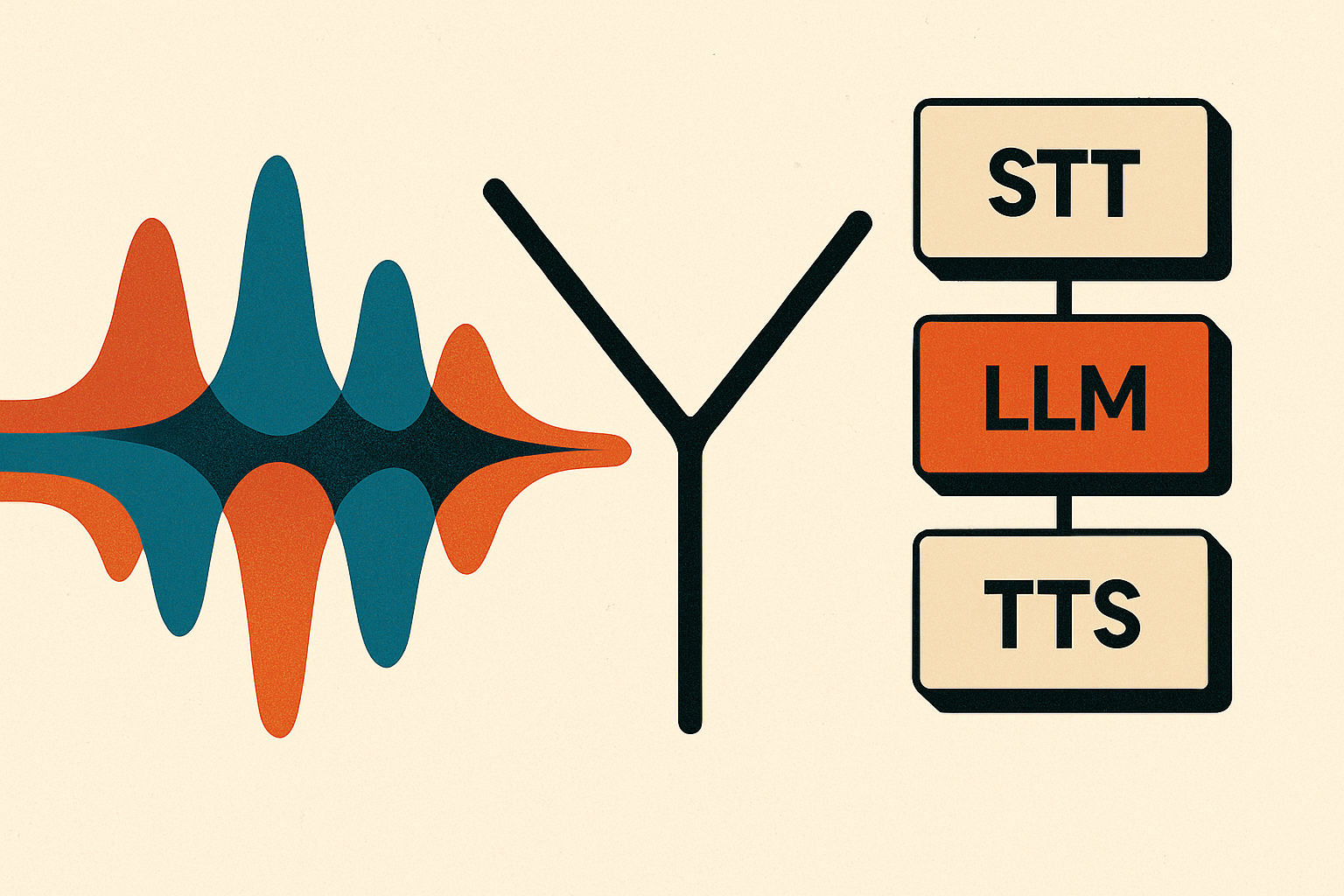
Full-Duplex Voice Is the Headline. Cascaded Is Still the Product: Choosing a Voice Stack After GPT-Live
OpenAI's GPT-Live made 'listen and speak at the same time' the story of the week. It's real — and it's ChatGPT-only, no API. Here's what full-duplex actually changes, what it breaks, and the stack you'll still ship.
5 min
Higgs Audio v3: A Chat-Native Open TTS for Voice Agents — With a License You Have to Read
Boson AI's 4B model speaks before the sentence is finished, which is the right shape for a voice agent. The catch isn't quality or speed — it's the non-commercial license on the exact use case it was built for.
4 min
Speaker Diarization for Voice Agents: pyannote vs NVIDIA NeMo vs Cloud APIs
Builders keep wiring diarization into the live loop of a one-on-one voice agent. There, it solves a problem you don't have — because you already own one of the two voices.
5 min
OpenAI Realtime API vs Gemini Live API: Picking a Voice Agent Backend
Gemini's audio tokens look 10x cheaper than OpenAI's — until you learn it re-bills the whole conversation every turn. The real fork is transport, not price.
4 min
Turn Detection for Voice Agents: VAD vs Semantic End-of-Utterance
The reason a voice agent feels rude is almost never its voice. It's that the agent confused "the user stopped making noise" with "the user is finished" — two different questions a silence timer cannot tell apart.
4 min
Speech-to-Speech vs Cascaded: Two Architectures for Voice AI Agents in 2026
The new realtime models hear and speak in one step, no text in the middle. That deletes the seam where you used to read, log, and control everything. Here's the real trade.
5 min
Cartesia vs ElevenLabs vs Kokoro: Choosing TTS for Voice Agents
For a voice agent, the number that decides the experience isn't audio quality or even the vendor's model latency. It's production time-to-first-audio — and the gap between the two is where the choice actually lives.
5 min
LiveKit vs Pipecat vs Vapi: Building Voice AI Agents in 2026
Every "voice agent framework" comparison pretends these three are the same tool. They sit at three different layers of the stack, and picking by features instead of layer is how teams end up rewriting.
5 min
Deepgram vs AssemblyAI vs Whisper: Speech-to-Text for Voice Agents in 2026
Whisper tops the accuracy leaderboard and loses the conversation. For a live voice agent, the number that decides whether the bot feels human isn't word error rate — it's who detects the end of your turn.
5 min
Tool Highlight: Smallest.ai — Production Voice Agents a Solo Founder Can Actually Ship (Voice 4.0, Lightning V3, 5-Second Cloning)
The India-based voice-AI shop just raised a $13M Series A and shipped Voice 4.0 with a parallel 'Hydra' architecture, plus Lightning V3 TTS: 15 languages, mid-sentence language switching, and production voice cloning from about five seconds of audio. Here's what it is, who's behind it, how to start, and what it costs.
3 minLatest in Voice Agents
Not buyer's guides — the news, teardowns, and explainers behind this topic.