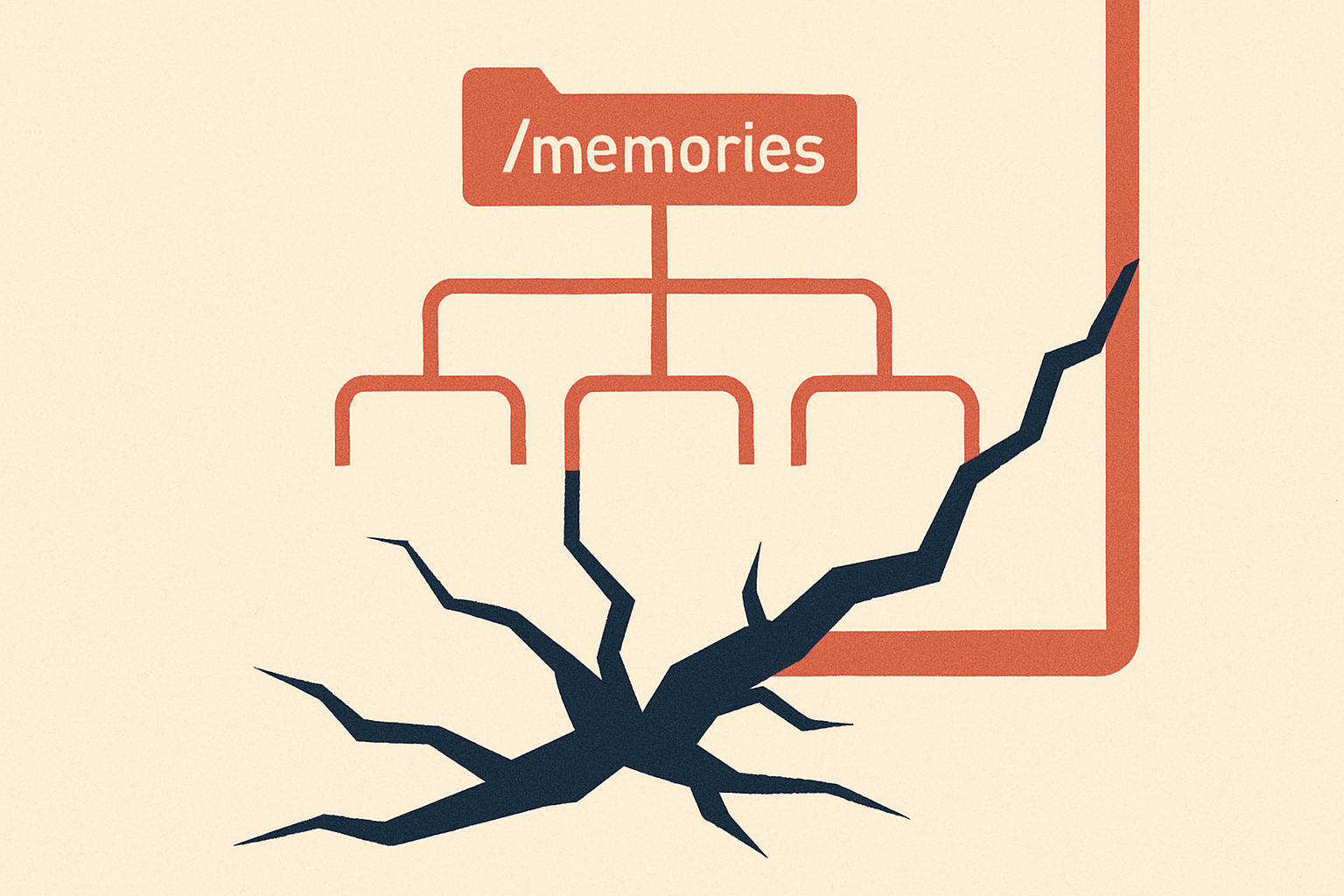
Anthropic's memory tool gives Claude a /memories directory it can read and write across sessions. But the directory is a fiction, the store is your code, and so is every line of the security.
Subagents let Claude delegate a few tasks per turn. Dynamic workflows fan out hundreds. The line between them isn't how many agents you need — it's whether the plan is stable enough to freeze into a script.
The token-share charts everyone is quoting measure the wrong thing. On the same marketplace where Chinese open-weight models now move most of the tokens, Anthropic — with roughly an eighth of the volume — still captures nearly half the revenue. That gap is the whole story.
For a decade the advice was "stop polling, use webhooks." The agent runtime quietly broke the webhook's core assumption — so the newest async surfaces ship polling first.
Sharding vectors is nothing like sharding rows. The real decision isn't where the data lives — it's how many shards each query is allowed to skip, and what recall you pay to skip them.
MCP's 2026-07-28 spec deletes the session handshake that ops teams quietly used to stitch an agent's tool calls together in their logs. The replacement is W3C Trace Context — and it doesn't do the same job.
The overflow that kills agents happens at the one boundary the MCP spec never paginated — the tool result. And the reflex fix, truncating to N characters, is the only option that's strictly worse than doing nothing.
A neocloud that owns none of the models it serves just booked $1.15B a year. The number that matters isn't the valuation — it's that open-model inference outgrew the labs whose weights it runs.
Mozilla shipped a one-call API that turns any URL into structured JSON, cited research, or a finished browser task. The pitch isn't the features — it's that it obeys robots.txt on purpose.
A new multi-turn coding benchmark reconstructs 109 real user sessions and scores agents on a second axis SWE-bench never had: not just whether they finished, but how much you had to steer them there.
A cache that skips a duplicate chatbot answer is a savings. A cache that skips a duplicate agent step is a wrong action. New 2026 benchmarks show the standard tools score under 40% — and the fix is the opposite of what you'd guess.
Wrapping every model call in retry(3) feels responsible. Under a provider brownout it's the fastest way to turn a slowdown into a blackout. The fix is a budget, not more backoff.
Qdrant 1.18 shipped a Google Research quantizer that rotates your vectors before it compresses them. The rotation is the whole trick — and the reason it works on any embedding model.
V2's headline is the Harness. The change that will page you is smaller: the bare `openai:` prefix now resolves to a different OpenAI API, and no deprecation warning fires.
A 33B mixture-of-experts model that activates only 3B parameters per token now clears 63% on SWE-bench Multilingual — and ships under a Linux Foundation license. The active-parameter count and the license matter more than the score.
v0.17.8 added an `invalid_final_output` handler — a third failure layer that catches what the model itself produces at final output, not what your tools or guardrails do.
GLM-5.2, Kimi, and MiniMax all ship an Anthropic-compatible endpoint, so pointing Claude Code at them is a one-line base-URL swap. The model runs — but 'compatible' is a promise about the wire format, not about the harness features your bill and your speed depend on.
The vector-database benchmark wars are all fought on the read path — recall and QPS. Milvus 2.6 spent its headline engineering on the part nobody charts: the durability log, which it moved straight onto object storage.
LlamaIndex's new legal-kb reference app hands the agent findFiles, readFile, and grep — not a search() call. The quiet argument is that retrieval was never the model's job to outsource.
The Send API gives you the fan-out. Deferred nodes are how you get a correct fan-in — but only if you understand that defer=True is a queue-drain barrier, not a dependency resolver.
Choosing a checkpointer backend isn't a speed decision. It's a decision about what lifecycle you want your agent's state to have — a permanent ledger you can replay, or a searchable cache built to expire.
The parameter everyone reaches for limits the size of one reply. Agent bills don't blow up on reply size — they blow up on the number of replies. Cap the loop, not the token.
You press stop. Your socket closes. The GPU keeps decoding, the bill keeps climbing, and a half-finished tool call is still out there. Cancellation isn't a button — it's cooperation.
The speedup was never the bottleneck — the well-matched draft model was. DeepSpec ships the whole draft-training pipeline, MIT-licensed, with Qwen3 and Gemma as the default targets.
The dead-letter queue is a solved pattern — for messages. An agent task isn't a message, and the two places that assumption breaks are exactly where your reliability and your token bill live.
The axis that actually separates the open-source memory engines isn't graph vs vector — it's how much structure each one commits when it stores a fact, and that quietly decides which questions your agent can answer later.
The first Five Eyes guide for agentic AI names five risk categories. Read them as a builder and something jumps out — only one requires an adversary. The other four are your own architecture failing quietly.
China's companion-AI law regulates the emotional bond, not the model — so Doubao and Qwen switched their companions off rather than comply. If you ship a persistent persona, here's the tool-vs-companion line coming for you.
An agent is a chain of steps that each depend on the last, so a 24-hour batch window can't sit on the critical path. You can't batch the loop — but the token-heavy work around it is exactly what batch was built for.
 🎧 Listen
The Wire
🎧 Listen
The Wire