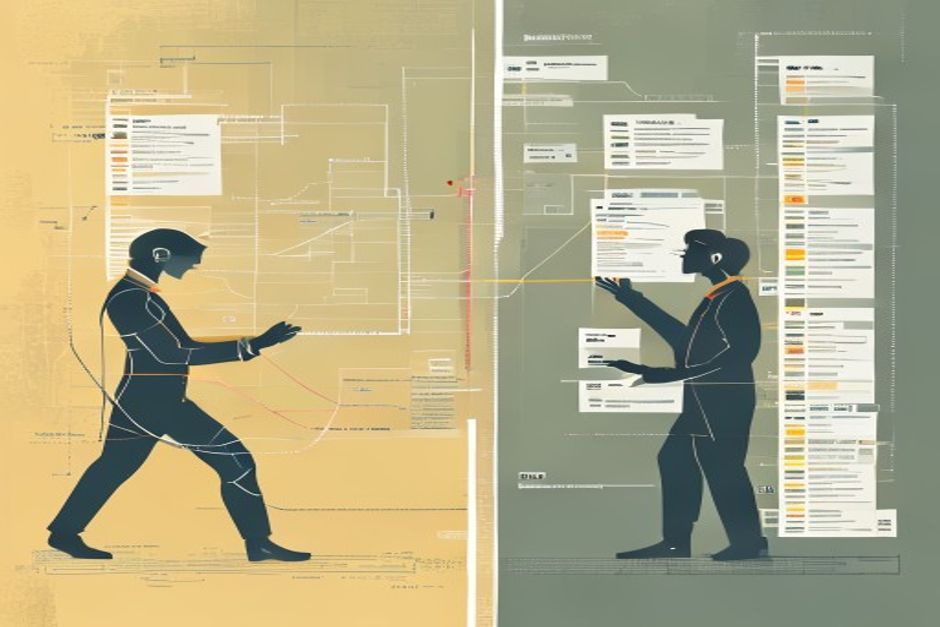
One reasons and acts in a single pass. The other retries the same task, writing itself a note on what went wrong. The difference isn't which is smarter — it's whether you have a success signal and can afford the second attempt.
Pydantic AI's V2 rewrite bets the whole framework on one primitive — the capability — and hides the loop. LangGraph makes the loop the product: nodes, edges, and a checkpointer you own. Here's which bet fits which team.
Pilot Protocol came out of stealth this week with 'the internet for agents' — every agent gets an address, discovers peers, and installs tools with no human in the loop. The company says 250,000 agents already joined, most without their owners knowing. That last clause is the whole story.
Microsoft's open-source Execution Containers add a third option to the agent-sandbox decision: enforce a policy on a process instead of renting a whole virtual machine. Here's the one axis that tells you which you actually need.
The 2026-07-28 stateless spec is final and a stable v2 SDK is targeted for the same day — but the official README still says 'v1.x for production, don't use v2 yet.' Here's the version to start a new server on this week, and the signal that tells you to move.
The final spec froze every feature into an Active, Deprecated, or Removed state with a 12-month removal guarantee. Here's the one-screen map of what to adopt today and what to design around.
Lovable is reportedly in talks to double to $13.2B after a $500M June run rate; Replit raised $400M at $9B. The category is valued on how fast revenue compounds, not on moats — which is exactly where a solo founder's lock-in risk lives.
Three tools keep winning the 'how do I see what my agent did' question — and they're not really competing. Each answers a different question. Pick by the one you actually have.
You've been watching token counts. The number that actually moves your bill and your latency is the share of your prompt that hits cache — and most agent designs quietly wreck it.
The open weights that landed July 27 aren't a full-precision checkpoint you shrink to fit — they're the model as trained. MXFP4 quantization-aware training changes two self-hosting reflexes, and getting them wrong costs you quality or memory.
The download is one click and the terms are not MIT. The Kimi K3 License lets you sell what you build — until a Model-as-a-Service crosses $20M, or your app crosses 100M users. Here's the clause that decides whether 'open' means open for you.
Kimi K3's weights landed and it took the open-weight crown on two benchmarks at once. For most founders that changes nothing: the decision is still license and serving cost, and on those K3 is often the wrong default.
The scariest agent bug isn't the call that fails. It's the call that succeeds — but the response gets lost, so your retry logic runs it again. One key, generated once and reused, is the fix.
ChatGPT and Perplexity increasingly send your first visitors — but only to pages they can parse. An llms.txt is a 20-line map that tells an AI engine what your site is and which pages matter. Here's the exact format, a copy-paste template, and the honest caveat about what it does and doesn't do.
A copy-paste walkthrough from an uninstrumented agent to a live multi-agent timeline in Honeycomb — using standard OpenTelemetry GenAI spans, so the same code also works with Langfuse or Phoenix later.
Every re-index, every retry, every duplicate document quietly re-embeds text you already paid to embed. An embedding cache is the boring, near-zero-risk optimization that a semantic cache gets confused with — and it's the one you should ship first.
Most multi-agent routing is a lookup you already know at author time, billed back to you as a model call. Here's how to route with plain conditions, and spend a token only on the one branch that's genuinely ambiguous.
One comes from production APM and correlates your agent with the whole system; the other is LLM-native and lives in prompts, cost, and eval scores. Here's which to standardize on — and why the choice is really about your daily workflow.
Both are the newest budget flagships from the two biggest US labs, both land within a point of each other on intelligence, and both are fast. So the decision isn't capability — it's price and which cloud you already live in.
Flash-Lite lands at $0.30 / $2.50 per million tokens — three times under GPT-5.6 Luna and Claude Haiku 4.5 on input. For the high-fan-out calls that don't need reasoning, it's the new cost floor. Here's the one job it's for, and the two where it will bite you.
Your agent doesn't fail because the model got dumb. It fails because you let its context window rot. Here is the four-move playbook — with the exact Claude API calls under each move.
You don't need Temporal to stop losing hours of work to a crash. Here's the minimum viable durability: serialize the loop's state to S3 after every step, resume from the last good one — and the one caveat that decides whether it's safe.
Dario Amodei's July 27 essay calls non-dangerous open models 'a public good' and aims its three real asks at chips, distillation, and frontier safety-testing — none of which touch a team self-hosting an open model in production.
The moment a task outlives one context window, builders reach for a bigger prompt — and it fixes neither failure. A long-running loop dies two unrelated deaths, and each has its own cure.
The '3 kinds of memory' talk ends the moment you have to pick a backend for tier three. Managed service, memory library, or your own vector DB — the fork is really about who writes the hard 80% you don't see.
Box shipped controls for how AI agents touch enterprise data. The real news is what it confirms: the security question now comes before the value question.
AI-agent startups still raised ~$1.8B in July 2026 — but ~62% went to Series B and later, at an average of ~$150M, to companies with $25M+ in revenue. The seed-stage land grab is over. Here's what that changes for a solo founder.
Five verified moves a team of one should act on: the biggest MCP revision since launch lands today, Europe's GPAI enforcement powers switch on August 2, a transformer-only chip startup doubles to $10.3B, and two open models change your cost math.
Four verified moves a team of one can act on today — the MCP deadline that's been on the calendar for months is now a published spec, the open-weight coding race stopped having one winner, and the budget model tier got cheaper again.
 🎧 Listen
The Stack
🎧 Listen
The Stack